Exercise Physiology Research: Emerging Directions, Translation, and Scientific Challenges l
Special Roundtable Discussion
“Exercise Physiology Research: Emerging Directions, Translation, and Scientific Challenges”
Written on June 30, 2026 by International Organization for Health, Sports, & Kinesiology (IOHSK)
Los Angeles, California, USA
Moderator:
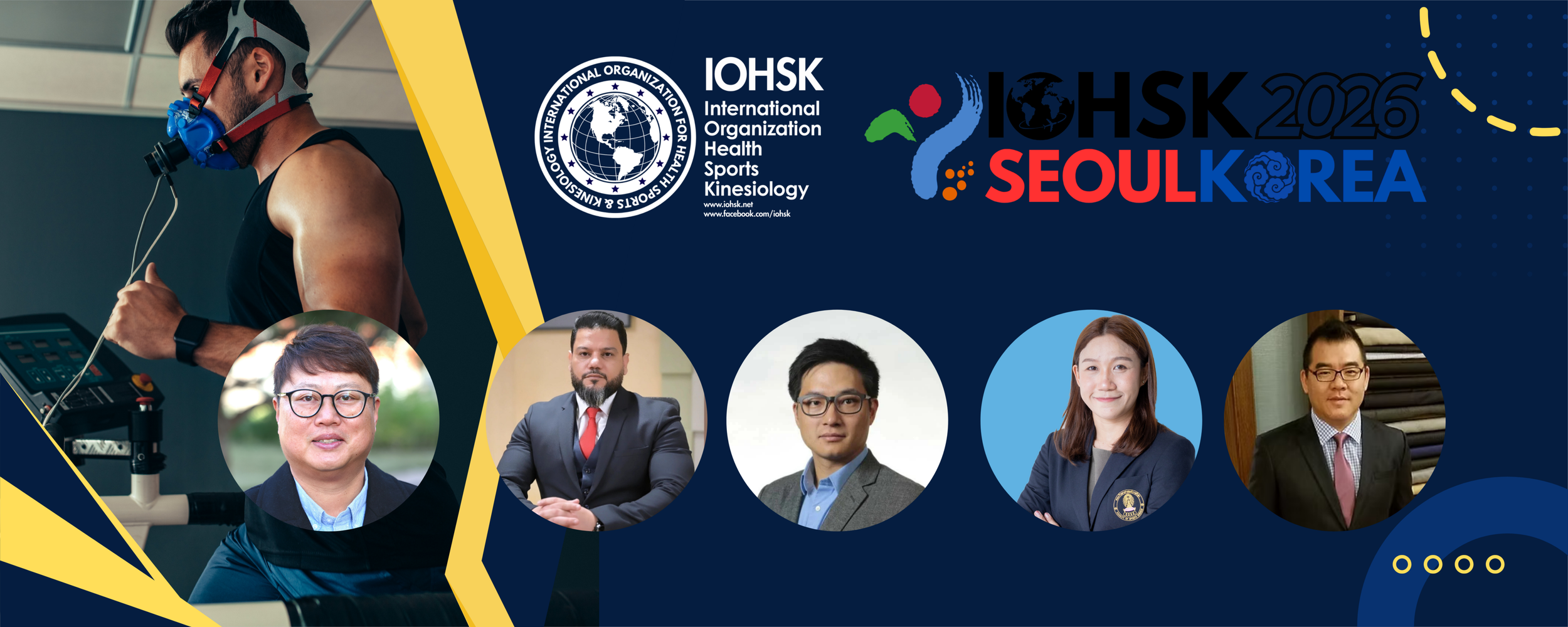
Dr. Yunsuk Koh (Baylor University, USA), IOHSK Vice President
Panelists:
Dr. Monoem Haddad (Qatar University, Qatar), IOHSK President of Middle East & Central Asia
Dr. Joon Young Kim (Syracuse University, USA), IOHSK Fellow
Dr. Kunanya Masodsai (Chulalongkorn University, Thailand)
Dr. Sang Ouk Wee (California State University, San Bernardino, USA)
Date: July 22, 2026 l Time: 3:10–4:00 p.m. l Location: Building 310, Room B501, Chung-Ang University, Seoul, South Korea
Event: 9th IOHSK International Conference
The 9th IOHSK International Conference is pleased to present a special roundtable discussion titled “Exercise Physiology Research: Emerging Directions, Translation, and Scientific Challenges.” This timely and interactive session will bring together distinguished scholars in exercise physiology to examine important developments, scientific challenges, and future opportunities within the discipline.
Moderated by Dr. Yunsuk Koh, the roundtable will feature Dr. Monoem Haddad, Dr. Joon Young Kim, Dr. Kunanya Masodsai, and Dr. Sang Ouk Wee as panelists. Drawing upon their international research and professional experiences, the panelists will discuss how exercise physiology can respond to rapidly changing health, environmental, and technological conditions while strengthening the translation of scientific findings into practical applications.
The session will begin with a brief welcome, an introduction of the moderator and panelists, and an overview of the major discussion themes.
The first theme, “Contemporary Issues in Exercise Physiology,” will explore the expanding role of exercise in the prevention, management, and treatment of major chronic diseases. Panelists will consider how evidence-based exercise interventions can be more effectively integrated into healthcare systems and delivered to diverse populations.
This theme will also address environmental exercise physiology, including the effects of climate change, heat, air quality, and other environmental conditions on exercise performance, athlete safety, and public health. The panel will discuss strategies for protecting individuals and optimizing physical performance in increasingly challenging environments.
The second theme, “Technology and Artificial Intelligence in Exercise Physiology,” will examine how wearable devices, digital health platforms, artificial intelligence, and training-load monitoring systems are transforming exercise research and practice. Discussion topics will include the validity and reliability of wearable technologies, comparisons between wearable and laboratory-based testing, and the potential role of artificial intelligence in experimental design, data analysis, health monitoring, and individualized exercise programming.
The third theme, “Building the Future of Exercise Physiology in IOHSK Through International Research Collaboration,” will focus on global cooperation and the harmonization of exercise physiology research. The panelists will discuss the standardization of exercise-testing procedures and physiological biomarkers, strategies for improving research reproducibility, and the methodological and logistical challenges associated with conducting cross-country studies.
One potential outcome of the discussion will be the development of an informal IOHSK International Exercise Physiology Research Framework. This framework could support future multinational research initiatives, encourage consistent research practices, and strengthen collaboration among IOHSK scholars and institutions around the world.
The session will also consider how international partnerships can help prepare the next generation of exercise physiologists. Topics will include student and trainee exchange programs, international mentoring opportunities, collaborative research training, and the scientific, technological, communication, and intercultural skills that future professionals will need.
An open discussion and question-and-answer period will provide attendees with an opportunity to engage directly with the moderator and panelists. The session will conclude with a brief synthesis of the key ideas, recommendations, and possible directions for future IOHSK research collaboration.
This roundtable is designed for exercise physiologists, health and sports scientists, researchers, educators, clinicians, graduate students, coaches, and other professionals interested in the future of exercise science. Through international dialogue and interdisciplinary collaboration, the session seeks to connect scientific discovery with practical application and contribute to a more innovative, inclusive, and globally connected future for exercise physiology.